Light from Alien Super-Earth Seen for 1st Time

Bliss

Well-Known Member
May 9, 2012

Light from an alien "super-Earth" twice the size of our own Earth has been detected by a NASA space telescope for the first time in what astronomers are calling a historic achievement.

NASA's infrared Spitzer Space Telescope spotted light from the alien planet 55 Cancri e, which orbits a star 41 light-years from Earth. A year on the extrasolar planet lasts just 18 hours.

The planet 55 Cancri e was first discovered in 2004 and is not a habitable world. Instead, it is known as a super-Earth because of its size: The world is about twice the width of Earth and has about eight times the mass of Earth.

But until now, scientists have never managed to detect the infrared light from the super-Earth world.

"Spitzer has amazed us yet again," said Spitzer program scientist Bill Danch of NASA headquarters in Washington in a statement today. "The spacecraft is pioneering the study of atmospheres of distant planets and paving the way for NASA's upcoming James Webb Space Telescope to apply a similar technique on potentially habitable planets."


Spitzer first detected infrared light from an alien planet in 2005. But that world was "hot Jupiter," a gas giant planet much larger than 55 Cancri e that orbited extremely close to its parent star. While other telescopes have performed similar feats since then, Spitzer's view of the 55 Cancri e is the first time the light from a rocky super-Earth type planet has been seen, researchers said.

Since the discovery of 55 Cancri e, astronomers have pinned down increasingly strange features about the planet. The researchers already knew it was part of an alien solar system containing five exoplanets centered on the star 55 Cancri in the constellation Cancer (The Crab). [Gallery: The Oozing Planet 55 Cancri e]

But 55 Cancri e stood out because it orbits extremely close to its parent star; about 26 times closer than the distance between Mercury and our own sun.

The new Spitzer observations revealed that the star-facing side of 55 Cancri e is extremely hot, with temperatures reaching up to 3,140 degrees Fahrenheit (1,726 degrees Celsius). The planet is likely a dark world that lacks the substantial atmosphere needed to warm its nighttime side, researchers said.

And to top it all off, the planet is oozing.

Past observations of the planet by the Spitzer Space Telescope have suggested that one-fifth of 55 Cancri e is made up of lighter elements, including water. But the extreme temperatures and pressures on 55 Cancri e would create what scientists call a "supercritical fluid" state.

Supercritical fluids can be imagined as a gas in a liquid state, which can occur under extreme pressures and temperatures. On Earth, water can become a supercritical fluid inside some steam engines.

The previous studies of 55 Cancri e were performed by analyzing how the light from its parent star changed as the planet passed in front of it, a technique known as the "transit method." In the new study, astronomers used the Spitzer Space Telescope to determine the infrared light from 55 Cancri e itself.

Spitzer's new look at 55 Cancri e is consistent with supercritical-fluid waterworld theory. The planet is likely a rocky world covered with water in a supercritical fluid state and topped off with a steam blanket, researchers said.

"It could be very similar to Neptune, if you pulled Neptune in toward our sun and watched its atmosphere boil away," said the study's principal investigator Michaël Gillon of Université de Liège in Belgium. The lead author is Brice-Olivier Demory of the Massachusetts Institute of Technology in Cambridge.

The research is detailed in the Astrophysical Journal.

NASA's $770 million Spitzer Space Telescope launched in 2003 and is currently in an extended mission to study the universe in infrared light. During that extended mission, telescope engineers modified several settings on the observatory to optimize its alien planet vision, NASA officials said.

The space agency's next major infrared space observatory, the James Webb Space Telescope slated to launch in 2018, could potentially reveal even more details about 55 Cancri e and other similar super-Earth planets.

"When we conceived of Spitzer more than 40 years ago, exoplanets hadn't even been discovered," said Michael Werner, Spitzer project scientist at NASA's Jet Propulsion Laboratory in Pasadena, Calif. "Because Spitzer was built very well, it's been able to adapt to this new field and make historic advances such as this."

super-earth-55-cancri-3-light-art.jpg1336505974

This artist's concept shows the super-Earth planet 55 Cancri e.
It's a toasty world 41 light-years from Earth that rushes around its star every 18 hours.


http://news.yahoo.com/light-alien-super-earth-seen-1st-time-215909030.html
 
Thank you for sharing bliss. Interesting.

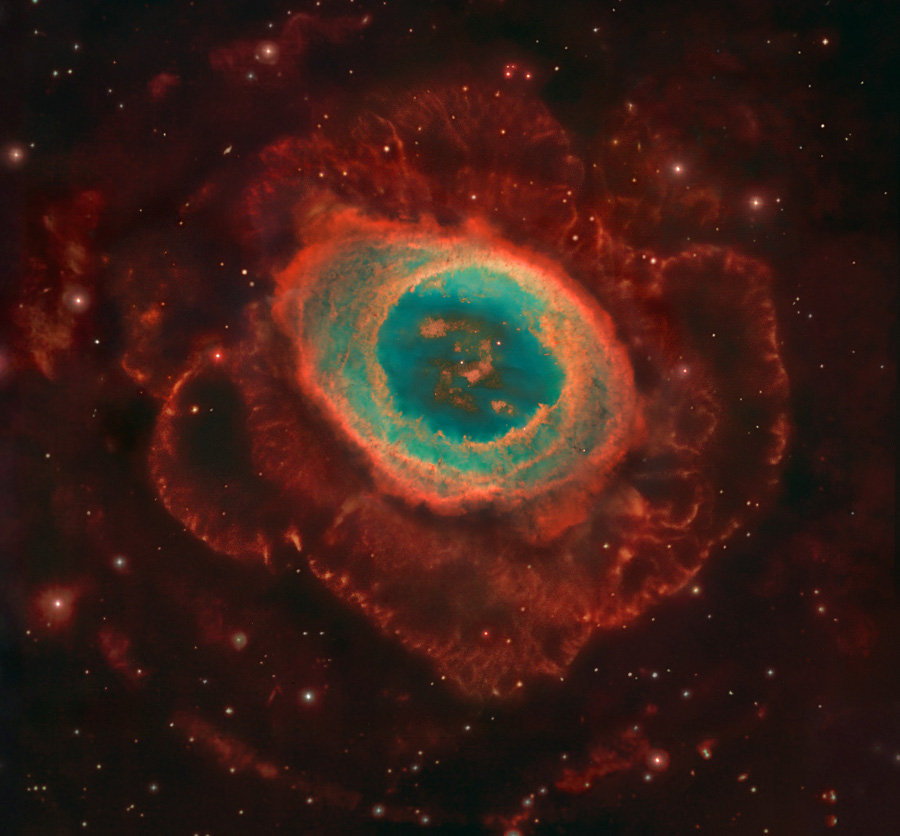
Nebula there was a pic of the day on Nasa of your namesake, a bit ago. Very cool pic.

M57-HST-Subaru-Sxgendler.jpg


M57: The Ring Nebula
Credit: Composite Image Data - Subaru Telescope (NAOJ), Hubble Legacy Archive;
Processing and additional imaging - Robert Gendler

Explanation: Except for the rings of Saturn, the Ring Nebula (M57) is probably the most famous celestial band. Its classic appearance is understood to be due to perspective - our view from planet Earth looks down the center of a roughly barrel-shaped cloud of glowing gas. But expansive looping structures are seen to extend far beyond the Ring Nebula's familiar central regions in this intriguing composite of ground based and Hubble Space Telescope images with narrowband image data from Subaru. Of course, in this well-studied example of a planetary nebula, the glowing material does not come from planets. Instead, the gaseous shroud represents outer layers expelled from the dying, once sun-like star at the nebula's center. Intense ultraviolet light from the hot central star ionizes atoms in the gas. Ionized oxygen atoms produce the characteristic greenish glow and ionized hydrogen the prominent red emission. The central ring of the Ring Nebula is about one light-year across and 2,000 light-years away. To accompany tonight's shooting stars it shines in the northern constellation Lyra.

http://apod.nasa.gov/apod/ap120420.html
 
Cool indeed

The Universe is, forever, fascinating.

Thank you for sharing bliss. Interesting.

Nebula there was a pic of the day on Nasa of your namesake, a bit ago. Very cool pic.

M57-HST-Subaru-Sxgendler.jpg


M57: The Ring Nebula
Credit: Composite Image Data - Subaru Telescope (NAOJ), Hubble Legacy Archive;
Processing and additional imaging - Robert Gendler

Explanation: Except for the rings of Saturn, the Ring Nebula (M57) is probably the most famous celestial band. Its classic appearance is understood to be due to perspective - our view from planet Earth looks down the center of a roughly barrel-shaped cloud of glowing gas. But expansive looping structures are seen to extend far beyond the Ring Nebula's familiar central regions in this intriguing composite of ground based and Hubble Space Telescope images with narrowband image data from Subaru. Of course, in this well-studied example of a planetary nebula, the glowing material does not come from planets. Instead, the gaseous shroud represents outer layers expelled from the dying, once sun-like star at the nebula's center. Intense ultraviolet light from the hot central star ionizes atoms in the gas. Ionized oxygen atoms produce the characteristic greenish glow and ionized hydrogen the prominent red emission. The central ring of the Ring Nebula is about one light-year across and 2,000 light-years away. To accompany tonight's shooting stars it shines in the northern constellation Lyra.

http://apod.nasa.gov/apod/ap120420.html

OH WOW! What a beautiful Nebula! Such stunning colors. This is screensaver worthy! LOVE IT, Jordan!! :smt060
 
403450_10151394127402275_354892872_n.jpg


Image of the Carina Nebula was taken on a 268-megapixel telescope.
Just to think.......
The distances between any 2 of these stars is so great that it must be measured in Lightyears......And to imagine 1-Light year is the distance light (which has a speed of 186,000 miles per second) will travel in one solar year ......Approximately 5.88 trillion miles.
Every time you look up at the stars, particularly outside our galaxy, you are looking back in time ....the stars you see might not even exist anymore because what you see is a snapshot in time of at least 800 years ago... And that is because it has taken the light from those stars at least 800 years to reach earth.......Trying to grasp the physics in space can be intimidating...
 
Ms. Bliss. Can you make this your signature thread like Ms. Tamstrong has done on the nature pictures. Can you provide in the future more photos and insights into the universe. This subject area is fascinating to me. I'm particularly interested in planetary sciences.
 
Back
Top Bottom