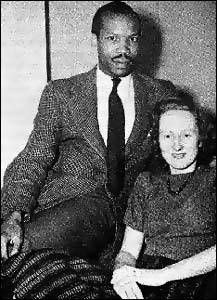
Sir Seretse Khama and his wife Ruth -- The love story that rocked the world...
Sir Seretse Khama was the first President of Botswana. He is internationally remembered for bringing peace and prosperity to the formative years of his nation.
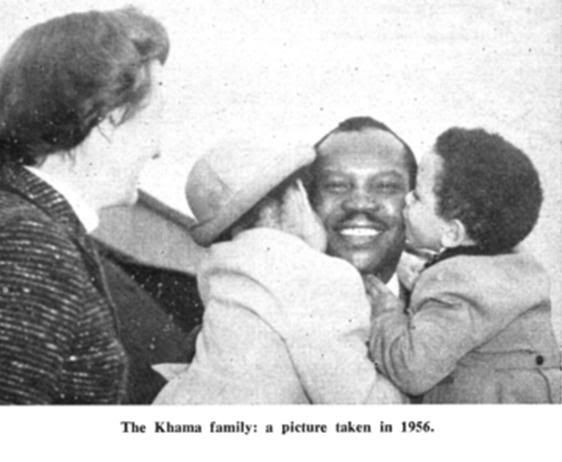
After marrying an English wife, Ruth Williams, in 1948, he was banned from the chieftainship and the territory of the Bamangwato. Allowed to return as a private citizen in 1956, he became an important member of the Ngwato Tribal Council, the African Advisory Council, and the Joint Advisory Council. He supported a motion for the introduction of a legislative council and spoke out strongly against racial discrimination. In 1961 Khama became a member of the new Legislative Council and was subsequently appointed to the Executive Council. In 1962 he was instrumental in founding the Bechuanaland Democratic party (BDP). In 1965 the BDP won the elections, and Seretse Khama became Prime Minister. The next year, Bechuanaland gained its independence from Britain. The new republic’s name was changed to Botswana, and Seretse Khama became its first President. He was knighted by Queen Elizabeth II in 1966.
As the new leader, Sir Seretse Khama showed great determination to develop his poverty-stricken and drought-ravaged country. He achieved free universal education and tried to strengthen the nation's economy. His major challenge was South Africa. Despite an overwhelming economic dependence on its southern neighbor, Khama had always made clear his abhorrence of apartheid, South Africa's policy of racial apartness. He had even deported a South African citizen for making racist statements. Despite a fundamental difference of philosophy, however, Khama managed to maintain reasonably cordial relations with his powerful neighbor and at the same time preserve an undisputed independence. In time, even Khama's in-laws softened on the marriage and often visited the state house in Gaborone. Khama was reelected to successive terms and remained president of Botswana until his death on July 13, 1980.
"We were taught, sometimes in a very positive way, to despise ourselves and our ways of life. We were made to believe that we had no past to speak of, no history to boast of. The past, so far as we were concerned, was just a blank and nothing more. Only the present mattered and we had very little control over it. It seemed we were in for a definite period of foreign tutelage, without any hope of our ever again becoming our own masters. The end result of all this was that our self-pride and our self-confidence were badly undermined. It should now be our intention to try to retrieve what we can of our past. We should write our own history books to prove that we did have a past, and that it was a past that was just as worth writing and learning about as any other. We must do this for the simple reason that a nation without a past is a lost nation, and a people without a past is a people without a soul." (Sir Seretse Khama, speech of Chancellor at University of Botswana, Lesotho and Swaziland graduation ceremony, 15 May 1970)
Read more
here here and
here
The love story that rocked the world...
A new book on the controversial love affair between Botswana's first president, Sir Seretse Khama, and his British wife, Ruth, is set to be turned into a major film. Ruth and Seretse, which was written by veteran Zimbabwean journalist Wilf Mbanga and his wife, Trish, while they were in living in exile in the Netherlands, seeks to tell the story of the "cross-racial marriage that rocked the world".
"There has been the telling of the love story of Anthony and Cleopatra, Romeo and Juliet - and now of Ruth and Seretse," says Mbanga.
Khama made headlines in Britain and South Africa in the late 1940s when he met and married Ruth Williams, a white English commoner, while in London. Their union led to Khama's exile from the then-Bechuanaland by the British government in 1951. He was only allowed to return after he renounced his title to the throne. When Khama returned to Bechu-analand as a private citizen, he formed the Bechuanaland Democratic Party, who won the elections and paved the way for Botswana's independence. Khama became the country's first president in 1966 - a post he stayed in until his death in 1980.
Khama is a "hero", says Mbanga, because he created a multiracial democratic society in Botswana. "He fought for majority rule in Botswana and he was knighted by Queen Elizabeth."
But the royal romance also has resonance for the Mbangas who were themselves victimised in the then-Rhodesia for their cross-racial marriage. They were forced to move to a farm outside racially-segregated Salisbury when they married in 1978 as whites and blacks were not allowed to live together.
"I can empathise with him. We have gone through some of the things that they went through. We met their families because we wanted to tell their story from their eyes - we wanted it to be a love story, not just a historical story. They were persecuted for loving each other and it caused them so much grief. In 1948 (South African) prime minister DF Malan denounced the British government for allowing the marriage to happen. But they were just two young people who fell in love - they weren't even politically aware," says Mbanga. A film company in Cape Town, where the Mbangas' daughter Rita works as a filmmaker, have bought the rights to the book, which is to be published later this year.
Read more here