
Navigation
Install the app
How to install the app on iOS
Follow along with the video below to see how to install our site as a web app on your home screen.
Note: This feature may not be available in some browsers.
More options
You are using an out of date browser. It may not display this or other websites correctly.
You should upgrade or use an alternative browser.
You should upgrade or use an alternative browser.
Movies with BM/WW Couples
- Thread starter Kid Rasta
- Start date

JamalSpunky
Well-Known Member
It's 2018 @JamalSpunky that's settling for something compared to the other IR out there with lead female characters. That's also a very narrow way at looking at the "complaining" when it's a deeper reason than that, but you act like you don't see it. It is only progress only if there wasn't a problem WITH intimacy between the characters which has ALWAYS been the main thing Hollywood steers clear from. The silhouette kiss in Guess Who's Coming To Dinner the absence of it in The Bone Collector. There was an online article during the late 90s that highlighted that. https://www.eonline.com/news/35283/black-men-can-t-kiss
When that is the BIGGER problem why be okay with the bigger problem looking at it as progress?
What you guys looking at as progress it boggles my mind that you see it that way when in actuality it has been done before with Julia Roberts, Angelina Jolie, Charlize Theron, Julianne Moore, Keira Knightley, Nicole Kidman, Bridgette Wilson, Mimi Rogers, Jennifer Aniston, ect.
It's not new man nor has it ever really been the problem.
It also sounds like you guys are accepting this privilege of even being CONSIDERED the white female central character's lover. When there are movies out there with the main white female character having a black lover with NO PROBLEM like A United Kingdom, The Mountain Between Us, CandyJar, 2 days in NY, Focus,The Anomaly, Little Boxes, ect. Not to mention the TV shows.
You and I don't always see eye-to-eye. There are certain things you champion as progress that I'm more meh about. And there are things you find underwhelming that I see as being important steps in the right direction or a leap forward. And that's okay. I respect where you come from and I want you to be you. Besides there are plenty of instances in which we agree.
I will stress that I don't think there has been anyone on this board more attuned to what I refer to as the Plantation Scenario, that in which white women are off-limits to black males but white men can have any female that he pleases, than me. I've been having this discussion for over a decade here. I've have collected articles and essays and books on the subject for even longer. It's a bit of an obsession of mine. This means I don't go around celebrating something that is a step backward for the presentation of black male-white female pairings on screen nor do I get overly excited by things that seem cautious or too tentative. I keep an eye out for actual shifts that could help change the landscape and sometimes I come here to talk about it with you guys. To some people's eyes on this site "Get Out" was a leap forward because it had a list of key ingredients that some of you want to check off : onscreen emotional intimacy, onscreen physical intimacy, scenes of tenderness, apparent commitment. But this movie never cleared my own hurdles because of the very fact that the white female was lying to her black fiance all along, was using him for her own sadistic means and never actually loved him. While I'm certain Jordan Peele didn't intend on this, the treacherous nature of the white female allowed the African American audience to embrace the film far more so than if she had actually been true to the black dude. And this portrayal allowed people to confirm their small, petty beliefs that a relationship a black man has with a white woman is fraudulent. It was Jungle Fever to the 10th power. That's a step back.
So here are some examples of what I see as progress in the year 2018:
1-Does a white female lead have a lover/boyfriend/husband who is black and someone she actually cares for and/or loves? If so that is progress even if there is not a lot of physical intimacy onscreen before. This may not seem great but the truth is we have rarely seen that in the history of western cinema.
2-Is this white female lead also THE central character of a movie from a major Hollywood studio? If the answer is yes then that is huge tilt forward because such examples are even more rare.
3-Is this white female lead played by an actress who is a rising star or considered still one of the A list actresses in the game or is she played by an actress who may still have some clout but is on the way down or played by someone who is clearly passed her peak as a major attraction? If its the former than that is progress.
4-Is the black guy she is paired with some actor whose clout is as strong or stronger than her, perhaps a bigger star; an individual that audiences are more likely to accept being paired alongside her because he is beloved in his own right? Or is the black actor chosen a guy who hasn't come close to achieving her level of fame and accomplishments and is therefore being elevated onto a higher platform of exposure? If it turns out the black dude is a less recognizable talent then its progress because it suggests Hollywood is allowing up and coming black actors or B/C level black guys to be placed in a position that could truly benefit their careers.
This new Chastain film has the potential to meet all of those important criteria I have laid out. We'll have to wait and see.
You tossed in examples like United Kingdom, A Mountain Between Us, Candy Jar, The Anomaly, Focus and Little Boxes.
United Kingdom is an epic love story based on true life events which meant that the only way to do the film was by casting a black male and white female lead. No one conjured up a fictional tale about such a pairing and sold it to Hollywood nor did any producer/director/studio take some gamble with racebend casting turning a pairing into an interracial one. The story was always about a black man and a white woman and it only came about because a black man was determined to have the story told; no one else, no studio was trying to make it. It also helped that the production was British and that the main stars were from the UK too. Britain is much more open-minded than America on this type of pairing. That said it was undeniably an example of progress.
The same could be said about A Mountain Between Us which did go the route or colorblind casting to give us a BM/WW pairing. And while Kate Winslet was on the decline at this junction of her career, her being paired with Elba still gave the movie star power. Even more noteworthy was that there was blatant physical intimacy between the two of them onscreen. A huge step forward, a movie that could serve as a landmark for the portrayal of black men-white women pairings on screen. But landmarks are such for a reason. They are a big deal that can lead to change but the change isn't always immediate.
I'm a sucker for Focus which I consider to be the best and most complicated romantic pairing between a black guy and a white woman in a mainstream film. Ever. The film, unlike Guess Who Is Coming to Dinner, is clearly about Will and Margot's character. And its a major studio film that provides gorgeous backdrops, beautiful on-location scenery and plenty of heat between two ATTRACTIVE leads with very nice chemistry. The two characters care about one another, are drawn to one another and have a sexy love scene, the type of love scene that white guys and white women as well as white guys and women of color get all the time without anyone batting an eye. And the two characters end up with one another. Now I will mention that the only way a black guy gets a romantic role like this is if he has huge clout like Will Smith, not to mention that the actress they set him up with was a relative unknown at the time. But who gives a fuck? Margot Robbie was hotter than 99% of more established young white actresses out there at the time. HUGE PROGRESS.
I recall seeing 2 Days in New York in the theater and that it wasn't as good as I was hoping it to be. That said to see such a pairing on the big screen in a romantic comedy was almost surreal. Shame it doing do better box office to influence more films coming after it but it was a positive step forward.
The others? Well...Candy Jar is cute. I think it was a small independent film that Netflix happened to purchase but nonetheless I was grateful that the black lead's love interest wasn't Latino or Asian. She was white. Progress indeed but a small one considered its scope, budget and overall buzz. Little Boxes? Come on. I appreciate it had a black husband and a white wife who had a black son. But so much about the movie is about the dysfunction of the family and how they struggle to keep it altogether. I appreciate the portrayal of such a couple as real people with real problems but we haven't gotten enough of the typical standard love stories to balance out this more down-to-earth portrayal. The Anomaly really looks like the equivalent of a cheap mid to late 80s Mario van Peebles action/sci fi flick, one that would have opened in like 20 theaters across the nation before heading to video. That period was also probably the last time in which a white female could be seen on the poster/cover of an action flick alongside her black male star as well as be his love interest without Black America making a huge issue out of it. I don't see this as progress in 2018 especially when you consider it too is a UK production. Different rules have applied over there.
(I'll continue this in another post)

ColiBreh1
Well-Known Member
@JamalSpunky Do you have different rules for TV shows or do use these same rules?You and I don't always see eye-to-eye. There are certain things you champion as progress that I'm more meh about. And there are things you find underwhelming that I see as being important steps in the right direction or a leap forward. And that's okay. I respect where you come from and I want you to be you. Besides there are plenty of instances in which we agree.
I will stress that I don't think there has been anyone on this board more attuned to what I refer to as the Plantation Scenario, that in which white women are off-limits to black males but white men can have any female that he pleases, than me. I've been having this discussion for over a decade here. I've have collected articles and essays and books on the subject for even longer. It's a bit of an obsession of mine. This means I don't go around celebrating something that is a step backward for the presentation of black male-white female pairings on screen nor do I get overly excited by things that seem cautious or too tentative. I keep an eye out for actual shifts that could help change the landscape and sometimes I come here to talk about it with you guys. To some people's eyes on this site "Get Out" was a leap forward because it had a list of key ingredients that some of you want to check off : onscreen emotional intimacy, onscreen physical intimacy, scenes of tenderness, apparent commitment. But this movie never cleared my own hurdles because of the very fact that the white female was lying to her black fiance all along, was using him for her own sadistic means and never actually loved him. While I'm certain Jordan Peele didn't intend on this, the treacherous nature of the white female allowed the African American audience to embrace the film far more so than if she had actually been true to the black dude. And this portrayal allowed people to confirm their small, petty beliefs that a relationship a black man has with a white woman is fraudulent. It was Jungle Fever to the 10th power. That's a step back.
So here are some examples of what I see as progress in the year 2018:
1-Does a white female lead have a lover/boyfriend/husband who is black and someone she actually cares for and/or loves? If so that is progress even if there is not a lot of physical intimacy onscreen before. This may not seem great but the truth is we have rarely seen that in the history of western cinema.
2-Is this white female lead also THE central character of a movie from a major Hollywood studio? If the answer is yes then that is huge tilt forward because such examples are even more rare.
3-Is this white female lead played by an actress who is a rising star or considered still one of the A list actresses in the game or is she played by an actress who may still have some clout but is on the way down or played by someone who is clearly passed her peak as a major attraction? If its the former than that is progress.
4-Is the black guy she is paired with some actor whose clout is as strong or stronger than her, perhaps a bigger star; an individual that audiences are more likely to accept being paired alongside her because he is beloved in his own right? Or is the black actor chosen a guy who hasn't come close to achieving her level of fame and accomplishments and is therefore being elevated onto a higher platform of exposure? If it turns out the black dude is a less recognizable talent then its progress because it suggests Hollywood is allowing up and coming black actors or B/C level black guys to be placed in a position that could truly benefit their careers.
This new Chastain film has the potential to meet all of those important criteria I have laid out. We'll have to wait and see.
You tossed in examples like United Kingdom, A Mountain Between Us, Candy Jar, The Anomaly, Focus and Little Boxes.
United Kingdom is an epic love story based on true life events which meant that the only way to do the film was by casting a black male and white female lead. No one conjured up a fictional tale about such a pairing and sold it to Hollywood nor did any producer/director/studio take some gamble with racebend casting turning a pairing into an interracial one. The story was always about a black man and a white woman and it only came about because a black man was determined to have the story told; no one else, no studio was trying to make it. It also helped that the production was British and that the main stars were from the UK too. Britain is much more open-minded than America on this type of pairing. That said it was undeniably an example of progress.
The same could be said about A Mountain Between Us which did go the route or colorblind casting to give us a BM/WW pairing. And while Kate Winslet was on the decline at this junction of her career, her being paired with Elba still gave the movie star power. Even more noteworthy was that there was blatant physical intimacy between the two of them onscreen. A huge step forward, a movie that could serve as a landmark for the portrayal of black men-white women pairings on screen. But landmarks are such for a reason. They are a big deal that can lead to change but the change isn't always immediate.
I'm a sucker for Focus which I consider to be the best and most complicated romantic pairing between a black guy and a white woman in a mainstream film. Ever. The film, unlike Guess Who Is Coming to Dinner, is clearly about Will and Margot's character. And its a major studio film that provides gorgeous backdrops, beautiful on-location scenery and plenty of heat between two ATTRACTIVE leads with very nice chemistry. The two characters care about one another, are drawn to one another and have a sexy love scene, the type of love scene that white guys and white women as well as white guys and women of color get all the time without anyone batting an eye. And the two characters end up with one another. Now I will mention that the only way a black guy gets a romantic role like this is if he has huge clout like Will Smith, not to mention that the actress they set him up with was a relative unknown at the time. But who gives a fuck? Margot Robbie was hotter than 99% of more established young white actresses out there at the time. HUGE PROGRESS.
I recall seeing 2 Days in New York in the theater and that it wasn't as good as I was hoping it to be. That said to see such a pairing on the big screen in a romantic comedy was almost surreal. Shame it doing do better box office to influence more films coming after it but it was a positive step forward.
The others? Well...Candy Jar is cute. I think it was a small independent film that Netflix happened to purchase but nonetheless I was grateful that the black lead's love interest wasn't Latino or Asian. She was white. Progress indeed but a small one considered its scope, budget and overall buzz. Little Boxes? Come on. I appreciate it had a black husband and a white wife who had a black son. But so much about the movie is about the dysfunction of the family and how they struggle to keep it altogether. I appreciate the portrayal of such a couple as real people with real problems but we haven't gotten enough of the typical standard love stories to balance out this more down-to-earth portrayal. The Anomaly really looks like the equivalent of a cheap mid to late 80s Mario van Peebles action/sci fi flick, one that would have opened in like 20 theaters across the nation before heading to video. That period was also probably the last time in which a white female could be seen on the poster/cover of an action flick alongside her black male star as well as be his love interest without Black America making a huge issue out of it. I don't see this as progress in 2018 especially when you consider it too is a UK production. Different rules have applied over there.
(I'll continue this in another post)

darkcurry
Well-Known Member
Progress in terms of what the racist in Hollywood tries to use as an excuse along with some black producers and that is the audience.
The audience has made these movies and shows popular as to the reason why we are seeing more of them, because those that want to normalize IR now have an audience. What you're looking for or hoping for will always be split. Which is why I don't get up and super excited for a mainstream actress doing an IR scene or having a love interest until I see how the story is done in terms of story. American audiences have turned out well for A United Kingdom(even in it's limited release) and The Mountain Between Us and REALLY well for FOCUS. And CandyJar was a social media hit among young folks when it was released if you type it into the search bars on google and twitter a lot of young folks liked it. And Cloak and Dagger, The Innocents just made the audience bigger and stronger. That is the progress that matters because it allows those in Hollywood TO normalize IR onscreen and not treat it different or put kid gloves on it when it comes to intimacy.
Even MBJ still with his Emmy nominated HBO movie was able to excel not only with being nominated but delivered in the ratings and on social media.
"1-Does a white female lead have a lover/boyfriend/husband who is black and someone she actually cares for and/or loves? If so that is progress even if there is not a lot of physical intimacy onscreen before. This may not seem great but the truth is we have rarely seen that in the history of western cinema."
^ I agree with that to a certain extent because intimacy is normalizing IR relationships onscreen which is what they have been proven to be against. I think it was said Denzel took out the kissing scenes in The Pelican Brief. Most racist don't like it when IR is normalized like that onscreen. Both in the business and the audiences. That's why I always look to how it is done. For example The Innocents, The Mountain Between Us wouldn't have worked without the intimacy. CandyJar would have.
The audience has made these movies and shows popular as to the reason why we are seeing more of them, because those that want to normalize IR now have an audience. What you're looking for or hoping for will always be split. Which is why I don't get up and super excited for a mainstream actress doing an IR scene or having a love interest until I see how the story is done in terms of story. American audiences have turned out well for A United Kingdom(even in it's limited release) and The Mountain Between Us and REALLY well for FOCUS. And CandyJar was a social media hit among young folks when it was released if you type it into the search bars on google and twitter a lot of young folks liked it. And Cloak and Dagger, The Innocents just made the audience bigger and stronger. That is the progress that matters because it allows those in Hollywood TO normalize IR onscreen and not treat it different or put kid gloves on it when it comes to intimacy.
Even MBJ still with his Emmy nominated HBO movie was able to excel not only with being nominated but delivered in the ratings and on social media.
"1-Does a white female lead have a lover/boyfriend/husband who is black and someone she actually cares for and/or loves? If so that is progress even if there is not a lot of physical intimacy onscreen before. This may not seem great but the truth is we have rarely seen that in the history of western cinema."
^ I agree with that to a certain extent because intimacy is normalizing IR relationships onscreen which is what they have been proven to be against. I think it was said Denzel took out the kissing scenes in The Pelican Brief. Most racist don't like it when IR is normalized like that onscreen. Both in the business and the audiences. That's why I always look to how it is done. For example The Innocents, The Mountain Between Us wouldn't have worked without the intimacy. CandyJar would have.

JUANMACKER
Active Member
Being a Christian film...no romance...but life long Interracial friends...
Unconditional 2012:
Unconditional 2012:
Soulthinker
Well-Known Member
I read about that flick for many years until I finally saw it on TCM. Hate the ending of course but it was a breakthrough flick . Richard Mulligan who plays the White ex later played in the show SOAP.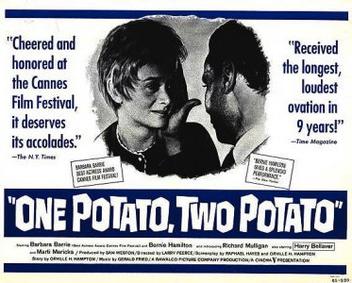

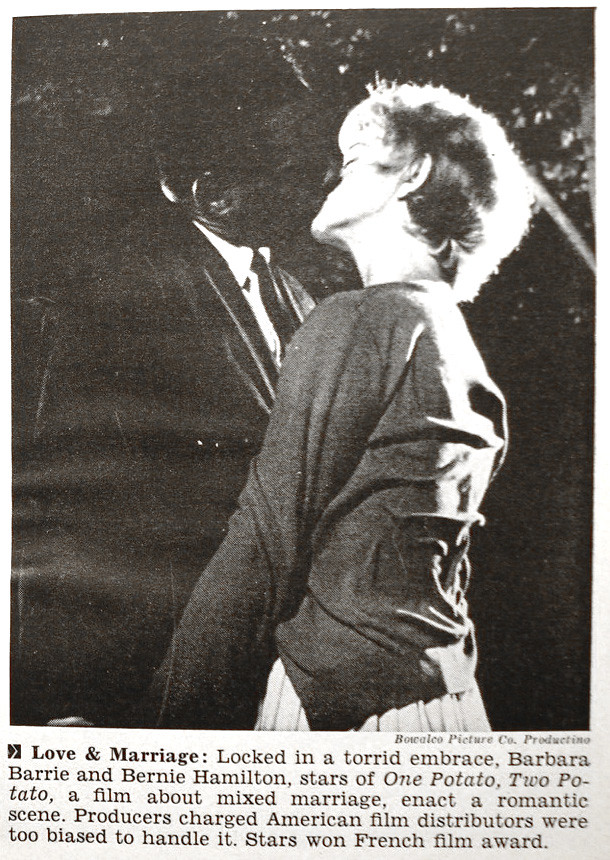

I just found and watched a movie called One Potato, Two Potato (1964).
This movie pushed the envelope more than Guess Who’s Coming to Dinner (1967) and was released three years earlier!
https://en.wikipedia.org/wiki/One_Potato,_Two_Potato
In an early example of "crowd funding," the $230,000 budget for ONE POTATO, TWO POTATO was supplied by approximately fifty private investors, mostly from New York City, who contributed as little as $500.
Photography was completed over a period of thirty-four days. No U.S. distributor was willing to handle the film, except for an unidentified major company, which declined after the producers refused to add a “cheerful” ending. Others anticipated a lack of interest from Southern exhibitors.
Director Larry Peerce, son of opera singer Jan Peerce, told the 13 July 1964 New York Times that he also offered the picture to the U.S. selection committee for the Cannes Film Festival. The three committee members who agreed to view the picture, Fred Zinneman, George Stevens, Jr., and Allen Rivkin, walked out after thirty minutes. Producer Sam Weston believed the scene in which Barbara Barrie kissed her African American co-star, Bernie Hamilton, was “too much” for them. While Peerce was seeking distribution in Europe, the selection committee in Cannes, France, agreed to screen the film at their upcoming festival, where it received a five-minute standing ovation, and won a best actress award for Barbara Barrie. Weston and Peerce recovered their production expenses after receiving an advance on royalties from overseas distributor British Lion Films.
The film opened 29 July 1964 at the Murray Hill Theatre in New York City. Openings followed at the Orpheum Theatre in Los Angeles, CA, and at the Beverly Cañon Theatre in Beverly Hills, CA, on 27 August 1964. Bernie Hamilton appeared at debuts in New York, London, and Paris. Reviews were mixed: While the the 9 September 1964 Los Angeles Times complained about the film’s lack of professionalism, the 8 May 1964 Daily Variety called it “a tactful look” at interracial marriage, and the 27 December 1964 New York Times listed it among the ten best releases of the year.
U.S. distributor Cinema V anticipated gross receipts of $1 million, with exhibitors from Virginia, Louisiana, and North Carolina bidding for the film. Out of the 250 Southern theaters that screened the film, only thirty to forty did not have an exclusively African American clientele. The film was very popular in Japan, where it was considered a compelling melodrama, rather than an exploration of U.S. race relations, of which the Japanese had reportedly little understanding.
Released three years before Guess Who’s Coming to Dinner (1967), and one year before the Voting Rights Act (1965), One Potato, Two Potato (1964) is about a white divorced woman who falls in love with and marries an African-American man. When her ex-husband sues for custody of her child, arguing that a mixed household is not a proper place to raise the child, the new African-American husband had to fight for his parental rights in court, fighting against a judge who represents the prejudices of the era.
Directed by Larry Peerce and shot in its entirety in and around the small northeastern Ohio city of Painesville, “One Potato, Two Potato” received all the cheers for displaying such emotional and political courage in telling the stories of interracial couples.
Lead actress, Barbara Barrie, for her role as Julie Cullen Richards, won the Best Actress award at the 1964 Cannes Film Festival.
The screenplay, written by Orville H. Hampton and Raphael Hayes, was also nominated for Best Original Screenplay at the 1964 Academy Awards.
Full movie via Youtube:
That one looks like it'll be tough to watch lolCAPTIVE STATE
John Goodman, Vera Farmiga, Ashton Sanders, Madeline Brewer.

ColiBreh1
Well-Known Member
Why not just list the actors involved in the IR in this movie instead of listing the whole cast? I have no idea who supposed to be involved with watching the trailer.CAPTIVE STATE
John Goodman, Vera Farmiga, Ashton Sanders, Madeline Brewer.
Last edited:
ColiBreh1
Well-Known Member
This "Ride" movie must be the film starring Bella Throne that @JamalSpunky has been talking about in this thread for over a year.
Interesting that Urban Movie Channel is producing this film.
darkcurry
Well-Known Member
Why not just list the actors involved in the IR in this movie instead of listing the whole cast? I have no idea who supposed to be involved with watching the trailer.
My fault. I just thought it would've been obvious if people watched the trailer that it was between Ashton Sanders & Madeline Brewer. Plus it is only a shot of them spooning in bed together because I thought potential IR couples were okay to post if it seems that way in the trailer.
darkcurry
Well-Known Member
It kind of gives me the feel of that Jamie Foxx, Jada Pinkett-Smith and Tom Cruise movie I think was called Taxi. I liked that movie. If the writing is as good as the concept seems in the trailer, I just might want to see this in theatres.

beeehave
Active Member
It kind of gives me the feel of that Jamie Foxx, Jada Pinkett-Smith and Tom Cruise movie I think was called Taxi. I liked that movie. If the writing is as good as the concept seems in the trailer, I just might want to see this in theatres.
The Tom Cruise-Jamie Foxx-Jada Pinkett-Smith film was called Collateral.
darkcurry
Well-Known Member
The Tom Cruise-Jamie Foxx-Jada Pinkett-Smith film was called Collateral.
Thanks I had trouble remembering and I was obviously way off!!! LOL!
But RIDE gives me that feel.
Soulthinker
Well-Known Member
Hope to see that flick soon.

ColiBreh1
Well-Known Member
Mudbound is a really good movie about two WW2 veterans (one black the other white) who strike up a friendship after returning home to the racist south to work on a farm with their families. There is an IR relationship between the black veteran and a European woman.
The movie is currently available on Netflix.
I read that in the book. Pleased they are including it in that flick. It is like a Emmitt Till type of a IR. Hope someone sees it since I don't have Netflix.
Uhhhhh... What do you mean by "Emmitt Till type of a IR"?
darkcurry
Well-Known Member
The Nutcracker and the 4 Realms has a black young man as the nutcracker, which at the very least is interesting. The nutcracker and ballerina/princess always have some sort of romance or hinted affection so will be interesting to see if Disney goes that route.
This looks actually good. I like how they just snuck it in their in a subtle way that he was The Nutcracker. However he seems to be more of her sidekick by the first trailer anyway than any hint of a romance. But I do know there was a cartoon way back in the day called The Nutcracker Prince that was a love story.
JamalSpunky
Well-Known Member
My illness kept me from coming to the site listing all of the three films discussed on this page. RIDE may not be any good but it passes all the tests, including showing an actual kiss between the black male and white female leads.
Learned couple of months ago about this young black actor who appears in the Nutcracker but didn't realize he had such a big part until I saw this most recent trailer and learned that he has his very own character poster. Don't know if there will be any hint of attraction (I wouldn't bet on it) but I'm sure more African Americans will be wasting their time pissed off that he appears to be British.
Learned couple of months ago about this young black actor who appears in the Nutcracker but didn't realize he had such a big part until I saw this most recent trailer and learned that he has his very own character poster. Don't know if there will be any hint of attraction (I wouldn't bet on it) but I'm sure more African Americans will be wasting their time pissed off that he appears to be British.