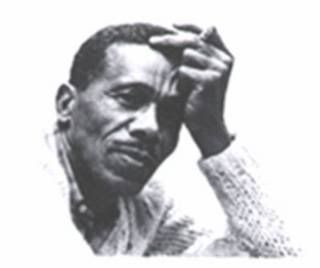
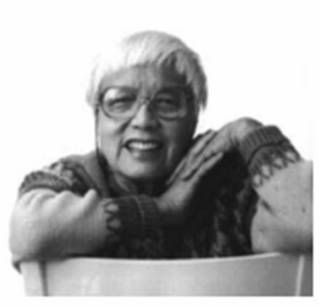
James "Jimmy" Boggs and his wife Grace Lee Boggs
James Boggs, born 1919, was a prominent African-American political activist, auto worker and author. He was married for forty years until his death in 1993 to Chinese American socialist and feminist activist, Grace Lee Boggs.
An African American born and raised in Alabama, Jimmy Boggs migrated to Detroit in the 1930s and worked for three decades as an autoworker and labor organizer. An organic intellectual, his book The American Revolution (1963) has been widely read by radicals within the US and around the globe.
From back of book American Revoution 1963:
"James Boggs, born in Marion Junction, Alabama in 1919: never dreamed of becoming President or a locomotive engi- neer. He grew up in a world where the white folks are gentle- men by day and Ku Klux Klanners at night. Marion Junction is in Dallas County where as late as 1963, although Negroes made up over 57 percent of the total county population of 57,000, only 130 Negroes were registered voters. After graduating from Dunbar High School in Bessemer, Alabama, in 1937, Boggs took the first freight train north, bumming his way through the western part of the country, working in the hop fields of the state of Washington, cutting ice in Minnesota, and finally ending up in Detroit where he worked on WPA until the Second World War gave him a chance to enter the Chrysler auto plant. He has been an auto worker ever since, and a rebel for as long as he can remember. The American Revolution has been translated into French, Italian, Japanese, Spanish, Catalan, and Portuguese."
Boggs was active in the far left organization, Correspondence Publishing Committee led by C.L.R. James from around the time it left the Trotskyist movement in the early 1950s until Boggs and Grace Lee Boggs led a split in 1962, breaking with C.L.R. James. In later years, he would play an influential role in the radical wing of the civil rights movement and interacted with many of the most important civil rights activists of the day including Malcolm X, Ossie Davis and many others.
Read more here
Grace Lee Boggs (born June 27, 1915) is an author, lifelong anti-racist activist and feminist. She is known for her years of political collaboration with C.L.R. James and Raya Dunayevskaya in the 1940s and 1950s. She eventually went off in her own political direction in the 1960s with her husband of some forty years, James Boggs, until his death in 1993.
Grace Lee Boggs is an activist, writer and speaker whose more than sixty years of political involvement encompass the major U.S. social movements of this century: Labor, Civil rights, Black Power, Asian American, Women's and Environmental Justice.
Born in Providence, R.I. of Chinese immigrant parents in l915, Grace received her B.A. from Barnard College in l935 and her Ph.D. in Philosophy from Bryn Mawr College in l940. In the l940s and l950s she worked with West Indian Marxist historian C.L.R. James and in l953 she came to Detroit where she married James Boggs, African American labor activist, writer and strategist. Working together in grassroots groups and projects, they were partners for over 40 years until James death in July l993. Their book, Revolution and Evolution in the Twentieth Century, was published by Monthly Review Press in l974.
In 1992, with James Boggs, Shea Howell and others, she founded DETROIT SUMMER, a multicultural, intergenerational youth program to rebuild, redefine and respirit Detroit from the ground up, which completed its twelfth season in the summer of 2003. Currently she is active in Detroit Summer and with the Freedom Schoolers, and writes for the weekly Michigan Citizen. Her autobiography, Living for Change, published by the University of Minnesota Press in March l998, now in its second printing, is widely used in university classes on social movements and autobiography writing.
Her many awards include:
1993: Human Rights Day Award, Center of Peace and Conflict Studies, Wayne State University.
1998: Zenobia Paine Drake Award, Black Family Development.
2000: Discipleship Award from Groundwork for a Just World.
2000: Distinguished Alumnae Award, Barnard College.
2000: Chinese American Pioneers Award, Organization of Chinese Americans.
2001: Women's Lifetime Achievement, Anti-Defamation League.
2002: Legacy Award, Museum of Chinese in America, New York City.
2004: Grassroots Peacebuilder Award, Peace Action of Michigan.
2004: Senior Celebrity Award, Bridging Communities, Detroit.
2004: Doctor of Humane Letters degree, College of Wooster.
2004: Interfaith Committee on Worker Issues Award.
2004: Lifetime Commitment Award, Michigan Coalition for Human Rights.
2005: Lifetime Achievement Award, Michigan Women's Federation.
2005: Community Honoree Award, WAND (Women's Action for New Directions).
2005: Urban Woman Writer in Residence, Department of Interdisciplinary Studies, Wayne State University.
2005: Lifetime Achievement Award, Detroit City Council.
2006: May - Marygrove College,The Theresa Maxis Award for Social Justice.
A plaque in her honor is displayed at the National Women's Hall of Fame in Seneca Falls, New York.
Read more here
Grace, Jimmy, love & vision
by Jack Lessenberry
If there is a more fascinating story of love and an intellectual partnership anywhere, I certainly don’t know it. Jimmy Boggs was a black autoworker from Alabama whose formal education stopped after a poor segregated high school.
Grace Lee was an older Chinese-American woman from Rhode Island. She had a Ph.D. in philosophy from Bryn Mawr and was a follower of an esoteric West Indian Marxist and cricket enthusiast, C.L.R. James. They met in Detroit in the early ’50s, where she had come to put out a newsletter. She invited him over to dinner.
They barely knew each other. He showed up an hour late; he said he didn’t like her lamb chops and sneered at her taste in music. Then — that same night — he asked her to marry him. She agreed, and what followed was an amazing 40-year partnership.
What could a half-educated Chrysler worker have to say to a philosopher? Well, plenty. Grace’s mentor opposed the marriage, in part because he feared she would become a follower of his. Jimmy Boggs was — there is no other word — brilliant.
This, however, might not have been immediately apparent to a journalist or even a higher species of pseudo-intellectual. Boggs often talked like an Alabama sharecropper, liked to work under the hood of a car, and would cheerfully tell you how a hog once mistook his toe for a sweet potato and nearly bit it off.
Yet after working on the line all day, he would stretch out on the floor of the aging house they rented and write rapidly in longhand, on a legal pad. The passage at the start of this essay comes from his first and probably greatest book, The American Revolution: Notes From a Negro Worker’s Notebook, which was published in 1963.
Essentially, the book says that “Marx’s concept of socialism had become irrelevant,” Grace Lee Boggs remembers, talking to me about her husband in the very room where he wrote his book. Marx wrote in a time of material scarcity, when capitalists could not make money if workers refused to work.
James Boggs, one of those workers, saw clearly — long before most labor leaders and sociologists — that machines were making work disappear and many workers irrelevant. “The time had come,” Jimmy wrote, “to stop depending on Marx and to do for our time what Marx had done for his,” remembers Grace, her eyes shining, her mind as clear and incisive as ever. That’s what the two of them tried to do together, for decades.
They wrote and they marched and demonstrated. Grace and Jimmy organized neighborhood groups to fight crime by discouraging the purchase of “hot goods,” to demand to be treated with dignity, to try and figure out how to create a more fully human life for everyone. They fought incessantly to make a new American Revolution in a postindustrial Detroit that was largely crumbling and abandoned. They were, for most of their lives, ignored by the local media — and celebrated internationally.
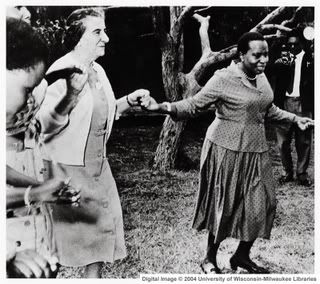
Ossie Davis and Ruby Dee were visitors at the house on Field Street. Kwame Nkrumah told Grace, quite seriously, that if she had married him they could have changed all Africa. Shortly after Jimmy’s book was published, without much fanfare by the little Monthly Review Press, he got a fan letter from Bertrand Russell, the best-known philosopher of the age. A correspondence followed in which Boggs — respectfully — lectured the grand old man on what the duty of philosophers should be.
Tragically, Jimmy Boggs was a heavy cigarette smoker, which ended up killing him in July 1993. He was writing pointed letters to the Free Press and speaking to classes right up until just a few days before he died. Almost the last thing he did was inspire the still-flourishing Detroit Summer, which brings older generations together with kids every year to “rebuild Detroit from the ground up.”
Last thing he did in life, that is; he is still inspiring people. Grace still lives in the home they rented for decades on Field Street. She has a new landlord now: The Boggs Center to Nurture Community Leadership bought the house, and has converted the second floor to a combination office, conference area and dormitory. For further details on what she and the center are doing, check out
www.boggscenter.org.
Grace herself is still going strong; writing a weekly column in the Michigan Citizen, lecturing, traveling, mentoring. She doesn’t turn 88, after all, till later this month.
WHole article here








 She's a cutie. :wink: