This one is dedicated to you, Noble
(trying to to clear off my debt to you!)
The Titanic's only Black passenger
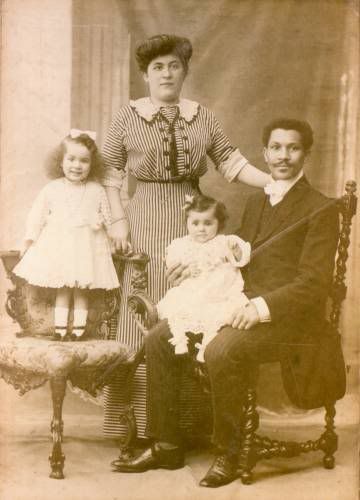
Joseph Philippe Lemercier Laroche and his wife Juliette Marie Louise Lafargue
Joseph Philippe Lemercier Laroche, who was born in Cap Haiten, Haiti, on May 26, 1889, came from a powerful family. Laroche's uncle, Dessalines M. Cincinnatus Leconte, was president of Haiti. The Laroches had been prosperous since the 17th century when a French captain named Laroche (in Haiti on military duty) married a young Haitian girl.
At the age of 15, Laroche left Haiti to study engineering in Beauvais, France. Several years later, while visiting nearby Villejuif, he met Juliette Lafargue, the 22-year-old daughter of a local wine seller. Although impressed by the handsome young Laroche, Lafargue's father, a widower, did not allow Laroche to marry his daughter until 1908, after he received his engineering degree.
A long way from his privileged lifestyle of Haiti, Laroche found France to be bleak and oppressive. Although Laroche was a cultured gentleman who spoke English and French fluently, and had an engineering degree, he couldn't find a job because of his color. It was a great disappointment to him that having earned his engineering degree in France he could not find employment there. No matter how qualified he was, the blackness of his skin kept him from securing a position that paid his worth.
Laroche's family was growing and there were no opportunities for him to support them. The couple's first daughter, Simonne, was born a year into the marriage, and their second daughter, Louise, was prematurely the following year and was sickly. They were living in Lafargue's home, and the mounting medical bills for baby Louise were draining the wine seller's profits.
Laroche, a proud and hardworking man, grew tired of having to rely on his father-in-law's generosity and decided to return to Haiti, where he would be guaranteed work in engineering. The family's plan to travel to Haiti was hastened, however, by the news that Juliette Laroche was pregnant once again.
Laroche's mother was so overwhelmed that her son was coming home with his new family that she purchased tickets on the French liner La France as a homecoming gift. When the couple realized that their children would not be permitted to dine with them on the liner, they exchanged their La France tickets for second-class reservations on the Titanic.
The Laroche family boarded the "palace of the sea" on Wednesday, April 10, 1912, at Cherbourg, France, for the scheduled five-day crossing to New York.
The Laroches did not have first-class reservations, but Laroche made it quite clear that his family was second-class to no one. The couple shared many of the spoils enjoyed by the first-class passengers. Their lounge was a large, spacious room with paneling in sycamore and was comparable to first-class accommodations on other sea liners of the day. Laroche, like other second-class passengers, also dined in the same saloon as the first-class passengers. Yet, the family's second-class tickets did not shield them from the stares and insults of being the only multiracial family in a sea of upscale Whiteness, and it is almost certain that the Laroches were frowned upon because of Laroche's Black skin and his interracial marriage to Juliette.
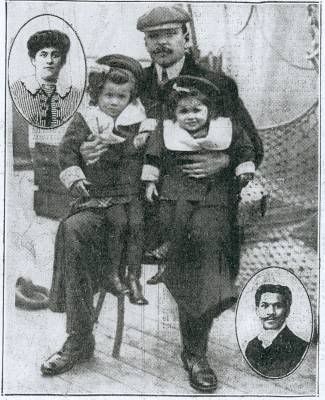
According to a few survivor reports, the Laroches were a handsome couple who conversed freely with some of the other passengers. But their charm did not eliminate the racism that was rampant aboard the ship, especially among the crew members. The White Star Line, the company that owned the Titanic, was forced later to issue a public apology for the derogatory statements made by the crew during the final moments on the doomed ship.
The days passed, bringing the Laroches and their fellow passengers to the unspeakable horror of Sunday, April 14, 1912, the day of the most tragic event in maritime history. Just before midnight, the Titanic, traveling at approximately 30 miles per hour, the highest speed it had ever achieved, hit a mammoth iceberg, causing five of the watertight compartments to flood.
Chaos erupted. Realizing that the liner could remain afloat for less than two hours, Captain Smith ordered the 16 lifeboats and four collapsible boats ready, and shortly afterward, women and children began boarding the lifeboats. Of course, the definition of "women and children" varied, as the evacuation process was unofficially labeled a survival of the richest. "In the popular imagination," historians Zero Z. Batzell Dean and Eric Klocko wrote in Children on the Titanic: Tragedy & Class, "men gallantly refrained from entering the limited number of lifeboats in order to allow the women and children to escape. Nevertheless, one had a better chance of surviving as a first-class man than as a third-class child."
Historians agree that Laroche was calm and heroic. Despite the pandemonium around him, he managed somehow to load his wife and daughters, possibly into lifeboat No. 14, which launched the port side at around 1:00 a.m. Laroche probably consoled his wife with frantic kisses and sweet promises of catching the next boat and reuniting with her later--but they both knew they would never see each other again.
The last lifeboat left at 2:05 a.m. Seconds before the liner went under, a number of third-class passengers, many of them women and children, surged from below deck. At 2:17, the ship's bow plunged under, the lights blinked and went out. From her lifeboat, Juliette Laroche watched in horror as the stern turned sharply upward, pointing to the sky, and finally sank to the bottom of the ocean, taking Joseph Phillippe Lemercier Laroche and some 1,500 other people to a watery grave.
What did Joseph Laroche do during his final moments? Did he curse his fate, or did he stand with the other doomed passengers and listen to the Edison Concert Band play "Nearer My God To Thee?" No one knows for sure, but given his courage, it is likely that he made peace with his ending and died with courage and valor. Almost half of the bodies of the victims were later recovered, but the body of Joseph Laroche was never found.
Juliette Laroche and her children remained in the frigid lifeboat for hours, without food. Finally, six hours later, the rescue boat Carpathia rescued the 705 Titanic survivors and delivered them to safety in New York, where she and her children received medical attention at St. Vincent's Hospital .
Poor and pregnant, Juliette Laroche decided to return to France to live with her father. A week before Christmas 1912, Joseph Lemercier Laroche Jr. entered the world, bearing a striking resemblance to his handsome father. This child brought much joy to his grandfather Lafargue, but the war erupting in Europe ruined the winery and thrust the entire family into poverty. On the advice of her father, Juliette Laroche sued the White Star Line for damages, but she filed her case too late. Lawyers came and went, no settlement arrived and Juliette Laroche, with her three children, lived in poverty through the first World War.
In 1918, six years after the death of her husband, the White Star Line awarded Juliette Laroche 150,000 francs, about $22,119 in 1918 and approximately $254,374 today. She took her settlement and opened a fabric-dyeing business in a room of the family's small home. Although she was now able to support her family, the Titanic tragedy scarred Juliette Laroche for life. Her love for her lost husband never waned, and she never remarried.
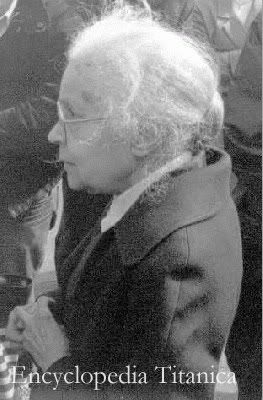
Louise Laroche was the last French Titanic lady. She passed away less than two years after this picture was taken. She died in Paris on 28 January 1998.
read more here
 and this one for you, Soulthinker